Thinking about getting professional assistance for academics? Then you need to share some details with the provider to get started with online class help.
First of all, you need to share your homework or assignment requirements. You may also need to share the additional details regarding your coursework guidelines. Apart from that, if you have opted for the online class management option, the experts would need your login credentials to access your school portal.
In this article, we have thoroughly discussed all the essential details a student needs to share with online class helpers. Keep reading to know more.
When you pay someone to do my online class, you need to share the following details for online class assistance:
The most critical information needed for online classes help services is the assignment & task details.
First, upload the assignment and specify guidelines for essays or projects. Also, inform the helper about the required format and citation Style (e.g., APA, MLA, Chicago, Harvard). Adding previous assignments as work samples helps the expert to align writing with your style.
It is also essential to specify the Grading Criteria that your instructor uses for evaluation. Lastly, do not forget to inform about the assignment due dates of the tasks.
Another important thing to share for online class support is the course content. Always share your course metadata. This generally includes Course Topic or Name, Subject, and Course Code. For better preparation, sharing the syllabus is ideal.
This includes the complete course schedule of the semester and the grading policy document of the institution. Also, it is best if you share textbooks like E-book access or PDF copies of required readings. Lastly, offer any specific announcements or emails regarding changes.
Ready to get started with online class help? Great! But, academic help online signup requires the credentials of the students. This is necessary when you are taking an online class management.
This is when an expert directly accesses the module on the digital portal while completing assignments. You need to share your LMS Login details, like URL, Username, and Password. You may also need to share the credentials for the associated school email account.
If your school uses third-party platforms like Pearson MyLab, McGraw-Hill Connect, or Aleks, then sharing logins of these external platforms is essential.
Other technical details needed to start the online class assistance service include:
Also, inform them about your specific location and timezone. This will ensure logins and submissions occur during “natural” hours.
Apart from these details, you also need to share your personal data with your helper. This includes your name and contact details, like your contact number and personal email address. In case of proctored exams, you may also have to share your personal IDs for the verification process.
Students often share their WhatsApp or Telegram links with tutors for better communication. However, this is entirely the student’s choice.
Always work with a reliable online class help service provider to trust with your important personal and academic details. Since the demand for educational assistance is very high, the market also has fraudsters.
Just as students ask questions in online classes to know the subject matter better, asking questions and requesting a sample helps you understand the service provider better!
If your details get exposed in the wrong hands, you may be in trouble. A lot of students have faced the following risks for trusting the wrong provider:
If you want to save yourself from these risks, read our tips for hiring an expert. Here we have discussed how to save yourself from fake providers by choosing the most reliable one. It is essential to select the services that are trustworthy and highly recommended before investing money or sharing details.
If you are looking for a reliable academic help service provider with whom you can trust with your academic and personal details, BoostMyGrade is the best choice. Here, we have a strict privacy policy in place to protect our students’ sensitive personal and academic data. All the records provided to us are erased as soon as the service is fulfilled.
We uphold our customers’ trust by providing fair and secure solutions. By choosing us, you can set yourself up for success instead of worrying about privacy. Contact us today and let us help you succeed!
Yes. Providing “Instructor Feedback History” is a crucial detail. Sharing past professor comments helps the assistant understand preferences. These include pet peeves and expected technical corrections. It also reflects feedback made on earlier work. The assistant then addresses expectations in future submissions.
For tasks requiring personal anecdotes, you must provide context. This includes brief details about your life experiences. Career goals or background relevant to the prompt. So the assistant can write a believable response. That sounds authentic and fits your situation well.
Yes, some assignments require peer-reviewed sources beyond the open web. You must provide library login or database access details. Examples include JSTOR or EBSCOhost for approved research. This ensures the assistant uses school-approved, high-quality sources. These resources meet the academic standards required for grading.
Yes. If your professor provides examples of high-scoring work. Sharing these Benchmark Samples is vital for accuracy. These details help mirror depth, formatting, and instructor expectations.
When school happens online, how to ask questions in online classes matters more than ever. Since digital classrooms differ from regular ones, students need new habits to adapt. Pausing before speaking allows learners and teachers to process ideas, making clarity easier. Thinking about possible answers first before asking a question helps students build insight, confidence, and smoother participation.
Tips rooted in real experience encourage natural engagement, balancing curiosity with discussion flow. These rhythms, not rigid rules, create an environment where students feel comfortable thinking, sharing, and contributing effectively. In many ways, these practices reflect the best ways to ask questions online and support meaningful learning in virtual spaces.
They have their own performance to elaborate the things
The process of virtual learning requires students to ask questions respectfully. This helps them learn more effectively during their online courses and ask effective questioning in virtual classes. Online courses often use discussion questions to improve students’ comprehension skills. The online environment creates difficulties for questions because it lacks body language and instant verbal responses, which makes it harder for people to recognize their significance.
Virtual classes use effective questioning methods to assist students in developing critical thinking skills while they participate in deeper learning experiences.
Still, if questions come at bad moments, they might interrupt class, mix things up for others, or slow everyone down. Knowing when to speak online or in person matters as much as speaking itself, especially for asking questions during online class without interrupting.
Effective questioning in virtual classes methods to assist students in developing critical thinking skills while they participate in deeper learning experiences is an essential part of the best practices for questions in online education.
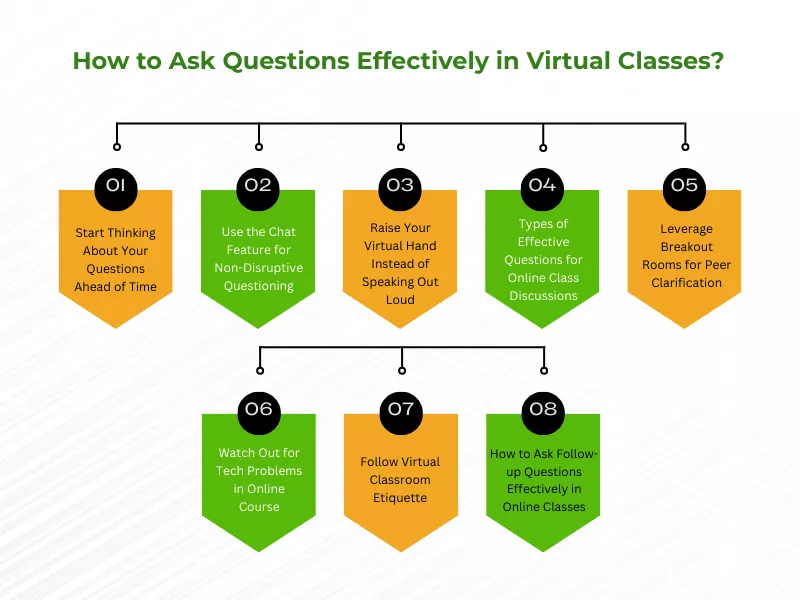
Getting your thoughts clear early helps ideas grow naturally. This habit supports preparing questions before online class sessions, making each question sharper and more purposeful during live discussions. Begin by preparing yourself for the semester using essential tools for online students. Once the class begins, you’ll find everything ready on your screen – the class waiting just like any other online course. Many learners appreciate this setup, especially when working without fixed real-time schedules.
Ready-made questions tend to shine better – sharper, narrower, simpler.
When talking in class, learners can send questions through a chat box. Focus holds the key, keeping discussions tied to the subject at hand. For replying, check what others just said. This way, participants stay on track without interrupting others, while also learning how to phrase questions in online class settings more clearly.
Say you want to talk about the part right after this lecture. Pointing to slide number seven by asking, “Does this formula fit the case shown here?” helps things move forward. It shows real curiosity instead of just checking off an answer. The way it’s framed makes it feel less like questioning and more like clearing up details of a person reading that would likely respond with an explanation rather than evasion.
At times, educators might turn to chat to gather questions, then answer them just when they matter most, keeping the class moving without pause.
A question comes up to check for understanding. Encouraging speech matters here. The “Raise Hand” tool works best without sounding harsh. Respect shows in how it is used, especially when students feel comfortable sharing their thoughts.
Only talk when your teacher says it’s okay, especially in an online teaching environment, to maintain a respectful atmosphere for critical thinking. Some students search for shortcuts like Pay someone to take my online class, but active participation and asking questions build stronger understanding in the long run. If someone shows slides or talks through tricky ideas, just wait—time moves faster that way. This way feels like being in a real classroom, only now it happens behind a screen, which encourages critical thinking in a digital environment.
Online class discussions depend on the questions that students choose to ask because both open-ended questions and choice questions determine the depth and effectiveness of their discussions. Instructors need clear questions that serve a specific purpose because this method enables them to provide effective answers, while students can participate without confusion. The most effective question types for online learning environments are listed below.
Example:
Breakout Room Activities and Essential Tools
Breakout rooms are small-group sessions in virtual classes that encourage collaboration, discussion, and hands-on learning. They create a supportive space that shows how students ask questions in virtual classes more confidently and naturally. Participants explore concepts through tasks, case studies, or problem-solving, with roles like facilitator or note-taker ensuring structure. Afterwards, groups share insights to reinforce understanding.
A good moment to speak up happens when the discussion shifts, not during it; this is one of the best practices for effective communication in an in-person setting and in a virtual environment. These habits also help students improve questioning skills in virtual classroom interactions. Breaking into smaller groups works well if someone needs to ask something quickly. Interrupting the speaker slows things down more than expected. Questions fit better after the main point has been covered, allowing for more targeted and general questions.
When kids gather in little teams, they usually sit more easily
To deal with Online Class Technical Issues, such as delayed sound, stuck videos, or dropped connections, it can be helpful to verbalize concerns to peers for better understanding. If someone asks a question too soon, problems pile up fast.
Students must solve online classroom technology issues by providing immediate solutions.
Asking questions becomes easier when people follow basic online behaviour rules, which include using appropriate question types.
Etiquette tips: remember to phrase your comments and questions clearly to facilitate better communication.
Before asking:
Thoughtful follow-ups demonstrate engagement and reflect strong tips for asking questions in virtual learning.

Right now, put these ideas into practice by drafting your questions beforehand. Each one is built to help without waiting.
A good approach to asking questions might involve typing in a chat window, lifting an agitated hand, inserting them into scheduled Q&A slots, or leaving them in online forums. Getting the moment right – and having materials ready ahead of time – helps minimize peaks in flow.
In essence, when learners stretch to share in chat or class discussions, it establishes an intervening space for asking live questions on course topics. Over weeks, working with the platform while practising different task styles during lessons slowly builds confidence. Every attempt makes guidance smoother, with clearer responses forming as they move through their experience.
Keep them concise, link them to the lesson or materials, and focus on one point at a time.
Absolutely. Basic questions often clarify essential concepts for you and your classmates.
Write it down and ask afterward via email, class forums, or the next Q&A session.


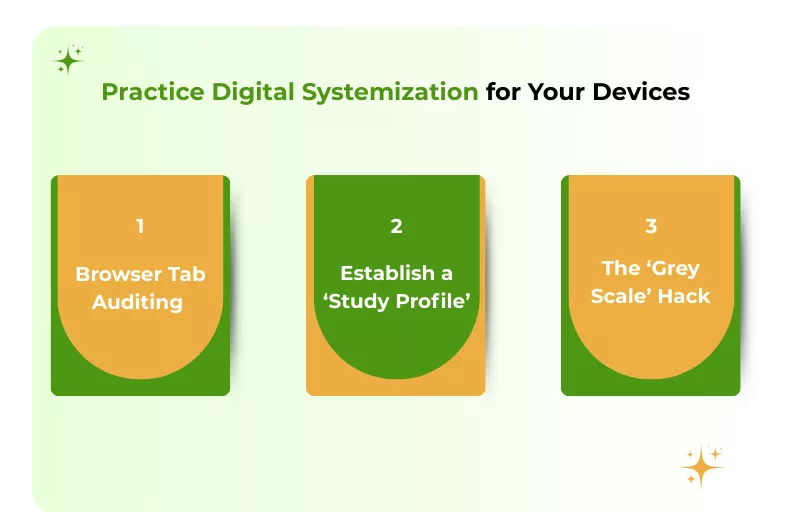
Online classes are primarily restricted to laptops. Therefore, to ensure you stay productive, it is crucial to treat your digital environment strictly. Here’s what you can do:
When you are preparing for your exams, you must use the ‘one tab’ rule or a browser extension that limits the number of open tabs. It reduces multitasking and cancels the visual noise that multiple tabs create.
You can create different user profiles on your computer. Create a ‘deep work’ profile that has zero social media logins, no bookmarks for entertainment sites, and a plain wallpaper. This automatically creates the environment and helps you concentrate on your studies.
Turn your screen to grayscale mode. This might sound weird, but it can actually help you control mindless scrolling on your phone during exam preparation.
Exams, midterms, and finals can be demanding. You need to implement the right techniques to ensure you are on top of it and are prepared for the exams. This way, you will be able to cope with the pressure and prepare well. Further, you have online class help websites to help you with the classes, exams, and assignments.
So, before you feel stressed about the exams, consider putting the strategies into action. You will be able to find a way to overcome the odds and do well in the midterm as well as the final exams.
A stressful semester can lead to burnout. To avoid it, you must set aside some time for self-care, eat healthy snacks, and get enough hours of sleep each night. It is also recommended that you use a planner or calendar to break down your study material and get some rest in between study sessions to avoid burnout.
The 3-2-1 study technique is about reviewing 3 key concepts, practicing 2 problems, and summarizing 1 key takeaway using active recall. The method helps boost retention, works best in short sessions, and helps you stay refreshed and ready.
It is recommended that students get 7-9 hours of sleep each night for focus, mental health, and overall well-being. Good night’s rest improves academic success, helps you stay ready to tackle exams, and prevents last-minute fatigue.
The 1-4-7 rule in studying is about reviewing study materials after 1 day, 4 days, and 7 days for improving long-term retention. The technique is an effective way to manage a long semester and to stay consistent without burnout.
A focused study session of 45-60 minutes followed by a short break will work best. It is wise to study in a free from distractions study space to stay motivated.
You can create a study schedule to ensure all study materials are easily accessible, supportive routines, and take care of yourself to deal with anxiety. Drink water throughout the day, avoid excess caffeine, talk to friends, and stay in touch with an online class help expert to get the necessary assistance whenever you need it.


Connecting with teachers and TAs during office hours to share your problems is not always possible. So, most students hire online class takers to fulfill academic goals. Here’s what you need to:
To avoid scams when hiring an online class taker, you must be clear about your requirements. If you are unclear about your requirements, you won’t get the best help!
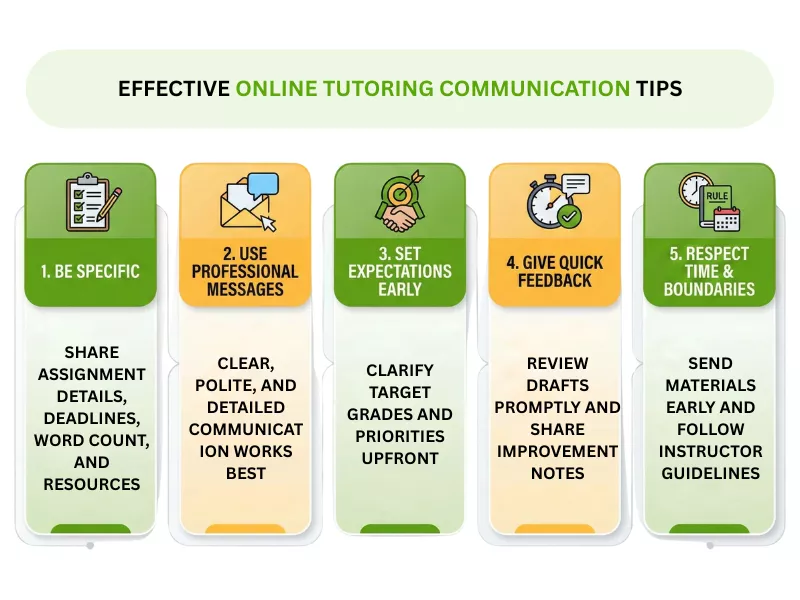
Therefore, don’t just say “do the homework.” Specify the module name, the due date, and the desired word count. If a specific reading is required, upload it to the portal immediately. The more details you provide upfront, the faster your class taker can start.
Students must never use slang or vague texts. Treat this like a business relationship. Instead of “Can u check this?”, try “Please review the draft for the Week 3 Discussion Board and confirm if it meets the rubric requirements.” Your subject matter expert will not only appreciate your behavior but also prioritise your work.
While online class management services can transform your academic life, before the course ramps up, tell your class taker what grade you are aiming for (e.g., “I need an A on the midterm, but a B is okay for discussions”). This helps them prioritize their efforts and aligns with your profile’s typical performance to avoid suspicion.
If your class taker uploads a draft, review it quickly. If the tone doesn’t sound like you, let them know immediately so they can adjust their writing style for future assignments. You are the master of your coursework, so share your feedback and concerns effectively to make sure they guarantee your success.
While BoostMyGrade offers 24/7 support, keep in mind that quality work takes time. Avoid sending login credentials within 2 hours of a major exam. Sending materials well in advance guarantees the best results. Furthermore, unless you properly share the teacher’s instructions, class takers won’t be able to follow everything and guarantee top grades.
Now, let’s see what online tutoring platforms communication features BoostMyGrade!
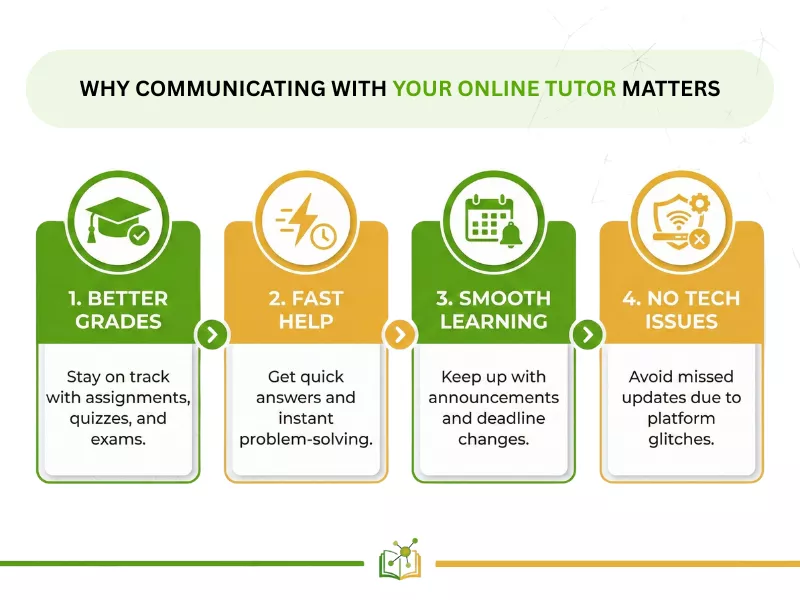
One of the best ways to talk to your online tutor or class taker is by using BoostMyGrade’s secure portal. When you read about us, you will find that we are popular because we offer direct communication with the class takers. At BoostMyGrade, we believe in transparency. While other platforms force you to route messages through support agents, we give you the keys to the car.
Watch this short walkthrough to see exactly how our Secure Student Portal works to keep you connected, anonymous, and organized:
As you can see in the video, our dashboard is designed to solve the communication chaos:
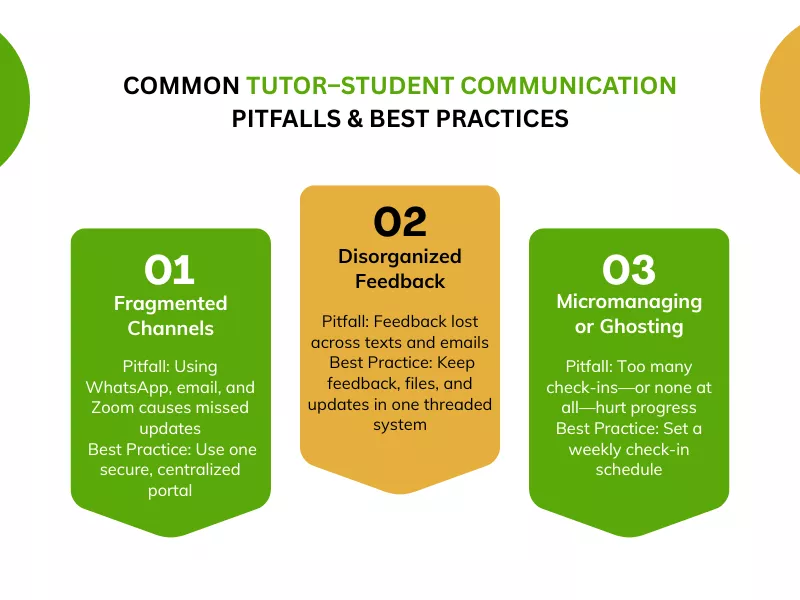
Freelance tutors often juggle multiple students across WhatsApp, email, and Zoom, leading to burnout and missed deadlines. In fact, online discussions often show tutors asking for advice on ‘how’ to communicate effectively because they lack a unified system.
The Best Practice: At BoostMyGrade, we replace this chaos with a dedicated, secure portal designed specifically for class management.
Independent tutors often struggle to find the right tools to provide feedback. A quick look at online tutor forums reveals that many private tutors are unsure whether to use email, texts, or random meetings to discuss progress. This leads to lost messages and vague feedback.
The Best Practice: Avoid the guessing game. At BoostMyGrade, we use a centralized system that stores feedback, files, and updates in a single, threaded, professional environment. You never have to worry if your tutor missed your text.’
Some students make the mistake of checking in every hour, while others vanish for weeks. Both behaviors harm your grade.
The Best Practice: To set a weekly check-in schedule via the BoostMyGrade portal. This ensures you are informed without overwhelming your class taker.
We hope this blog post explained well that direct communication with online class takers is vital. With so many tools available to facilitate communication between class takers and students, the online learning journey becomes smooth from the very beginning. BoostMyGrade ensures that when you send or receive information, no third party learns of it. Therefore, when you choose the right class help partner, you get instant communication using technology.
Once you create a dashboard with us, you can communicate at any time. While weekly updates ensure alignment on LMS deadlines, such as Canvas quizzes and daily for high-stakes exams, rest assured that our project managers will inform you after each task is completed. Therefore, if you need information in between, you can quickly communicate with them.
When you sign up with us, you need to provide us with your syllabus, login credentials, grading rubrics, and your writing style to avoid detection and hit targets.
Use secure portals like BoostMyGrade’s for privacy; however, you have other options like email for formal docs and chats for quick clarifications.
Unlike traditional class takers, top online class takers offer 24/7 access; schedule ahead and respect boundaries for the best results.
When you add comments or feedback, you must use your constructive criticism skill: “This draft is strong; tweak citations to match my style.”
Set expectations upfront with buffers; BoostMyGrade guarantees timely delivery via their portal.
With trusted services like BoostMyGrade, yes, via encrypted portals, never personal apps like WhatsApp.
To avoid scams when hiring an online class taker and help services, you must check for proper reviews, their support channels, guarantees, and policies. A website that does not uphold transparency, stay away from those websites.
Students struggle with the demands of online learning a lot. From maintaining deadlines and taking classes every day to be on top of everything, to completing numerous homework sets and participating in discussion posts, students fail to meet their personal and professional commitments. Evidently, most switch to online class takers so the experts can help students tackle classes better. However, the growing rise of fraud and online scams has made it increasingly difficult to trust them.
BoostMyGrade is one of the most trusted and reliable class help service providers for the last 14 years, and today we will help you make a better choice so you can avoid class taking services fraud.
Unlike premium and reliable take my online class services like BoostMyGrade, students complain about fraudulent behavior! Let’s learn in detail:
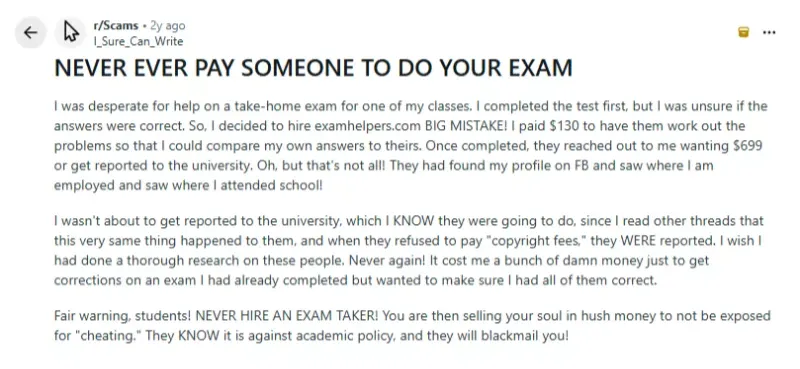
Illegitimate online class help sites often rely on fear, urgency, and secrecy to exploit students. While these services may initially appear professional, many operate with no accountability, no real policies, and no concern for student safety. Understanding how these scams work and knowing the proven methods for evaluating professionals helps students recognize scam warnings for hiring online class tutor before it’s too late.
One of the most dangerous and increasingly common signs of scam online class taking services involves academic extortion after payment. In these cases, students are first charged a small amount for exam or course assistance. Once payment and access are provided, the service escalates demands—threatening to report the student to their university unless additional “fees” are paid.
A widely shared post on an online scam warning forum describes a student who paid a relatively small fee for exam assistance. After receiving payment, the service demanded several hundred dollars more and threatened to report the student for academic misconduct.
What made the situation worse was that the scammers:
The student later discovered that others who refused to comply were actually reported, confirming that the threat was real, not a bluff.
Therefore, to avoid getting scammed by online exam help services, you must follow a proper guide to selecting a professional class taker!
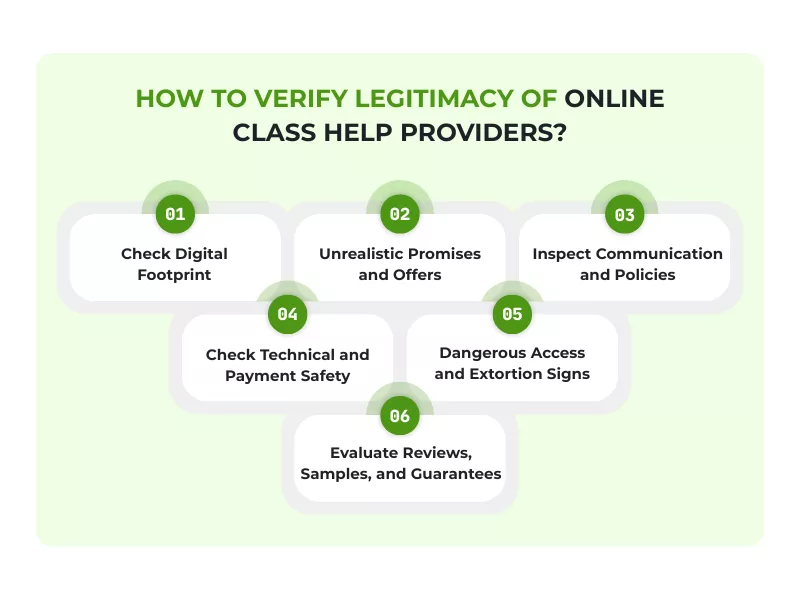
Before you decide to select a class taker or academic assistance, you need to verify if they are legit online class takers. So, how to find trustworthy online class services? We have made a checklist for you:
One of the most significant student tips avoiding online homework scams is checking for reviews not just on the website but also on third-party review sites and forums like Google, Reddit, and student forums. To detect fake class taker reviews, you need to look for a real website with About, Contact, and policy pages instead of only a WhatsApp contact.
Seeking online scam-free class assistance is sometimes an overwhelming task because while most services come with promises and offers, you need to understand the boundary that separates legitimate services from fake ones! Be cautious of claims like “guaranteed A+ or full refund” or “100% on any exam, no risk”. Safe and reliable services offer a money-back guarantee, but only when the class takers fail.
Furthermore, to hire online class help safely, you need to stay away from offers like “50% discount on all class help just for today.”
You can easily spot scams when looking for websites offering class help by reviewing their communication channels and policies. Many students have fallen prey to websites not respond properly. So, communicate with them via multiple channels that they offer or showcase on their website in wee hours. Also, check if they offer direct communication with the online class tutor. Therefore, check if refund, revision, and privacy policies are easy to find and clearly written.Fraudulent websites are mostly unclear about their policies.
Now, when you hire someone, you need to be careful about your financial and personal information. Select assignment writing services that use secure, trackable payment methods (cards, trusted gateways) that offer buyer protection. Moreover, look for basic site security, such as HTTPS and reputable payment processors. Though we know most students avoid services that accept nothing more than card payment, BoostMyGrade is one step ahead. When you pay us, your credit card says “Educational Services.”
For your academic integrity and financial well-being, be wary of anyone insisting on full control of your LMS, email address, or proctored exam account credentials. Legitimate services use remote screen-sharing tools to take classes and exams when students do not wish to share personal information. Most importantly, if they hint that they could “inform your school” or use your data against you later when you say otherwise to their deals, consider it a red flag and never sign up!
Lastly, focus on reviews that mention specific courses, timelines, and communication rather than only “great service”. Ask for anonymized samples or proof of past work in your subject area. Check for no plagiarism and a money-back guarantee. You must also ask for free research paper samples and free Turnitin reports with assignments.
If you wish to avoid academic penalties, you must submit an AI and plagiarism-free assignment, and only Turnitin shows the result properly. If they do not offer a free report, be aware! Now that you know all the red flags hiring someone for online classes, take action carefully!
From identity theft to account scams, knowing all about the scammers helps in making informed decisions. Be careful, as many students have been victims of them. The more questions you ask about tutors, the better you will know about the service because they exploit unsuspecting students a lot!
Yes, it is safe if you choose a legitimate and trustworthy platform like BoostMyGrade. We follow strict safety policies, have verified subject experts, and offer clear service policies. It is risky to work with anonymous or unverified providers.
Partial upfront payment is common. But we do not recommend paying 100% upfront to an unverified service. BoostMyGrade is one of the most trusted online class help service providers, and we offer payment flexibility, progress updates, and written refund or revision policies.
Look for reviews that have specific details about coursework, timelines, and a 24/7 support channel. At BoostMyGrade, we value honest customer feedback and encourage our students to review real experiences before making a decision.
The safest payment methods are those that provide transaction records and buyer protection, such as credit cards and secure online payment gateways. At BoostMyGrade, we use secure and verifiable payment systems to ensure transparency and your protection.


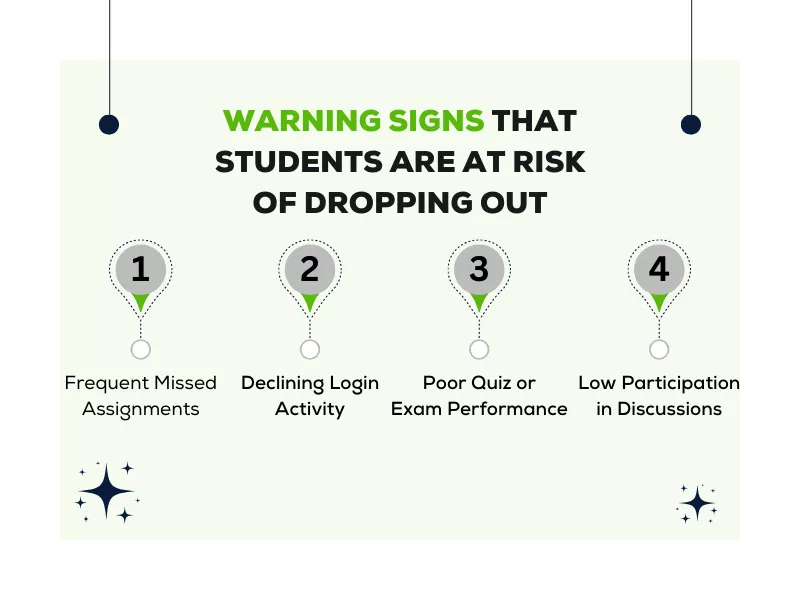
A teacher might think about how to prevent students dropping online courses? But the reality is that preventing online class dropout requires proactive strategies that address both academic and personal challenges. Since students drop out of online classes due to multiple overlapping factors, prevention must focus on structure, motivation, and support. College students particularly need comprehensive prevention strategies.
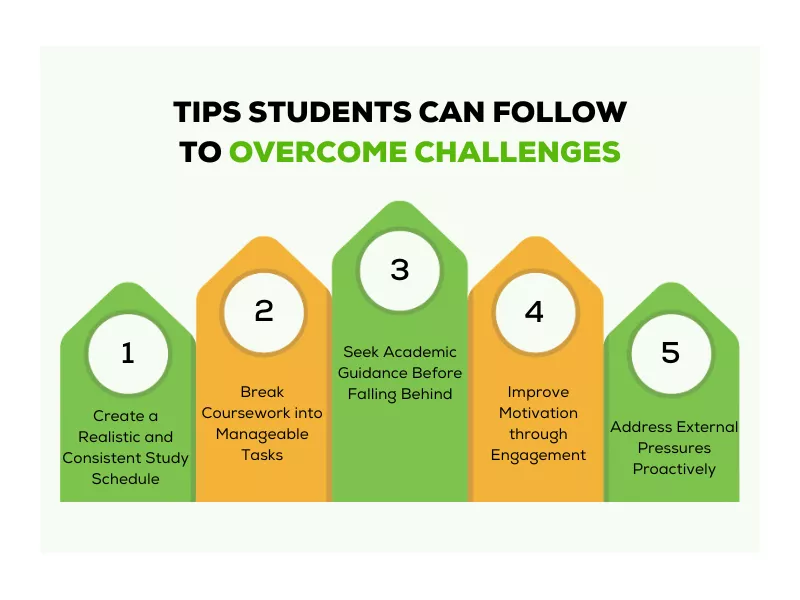
A flexible schedule is one of the biggest reasons why people quit online courses. Without fixed study hours, procrastination increases. Students should block dedicated time each week for lectures, assignments, and revision. A consistent routine directly reduces time management issues online course dropout risk. Balance is essential.
Large assignments can feel overwhelming, especially for working students. Breaking coursework into smaller weekly goals helps students stay motivated and prevents burnout. This approach is particularly effective in preventing working students drop out of online classes. Create achievable milestones. Easily find small wins to maintain momentum.
Many students wait too long before asking for help. Early academic guidance, whether from instructors, tutors, or trusted support services, can prevent small issues from becoming major obstacles. This strategy plays a key role in how to prevent students dropping online courses successfully. Provide multiple resources for help. Sessions with advisors make a difference.
Students are more likely to stay enrolled when they feel connected to their course. Participating in discussion forums, virtual study groups, and instructor-led sessions improves engagement and reduces the risk of dropout in online classes. Connection with peers is vital. Taking an active role in discussions helps. Interaction builds community.
Balancing work, family, and studies is challenging. Students should communicate with instructors about workload conflicts and plan during high-pressure periods. Proactive planning significantly lowers the chances that students drop out of online classes. Financial aid concerns should be addressed early. Find resources to manage stress. Offer flexibility when possible. Ensure students feel supported. Therefore, institutions must recognize these pressures.
The question of why students drop out of online classes doesn’t have a single answer. It’s an interplay of personal factors like lack of support, motivation, time management, technical skills, financial pressures, and institutional factors, course design, instructor quality, and support services. Understanding these dynamics empowers students to make informed decisions. Various elements contribute to this complex problem.
If you’re currently struggling with online classes, remember that dropping out isn’t your only option. Reach out to your instructor, utilize campus resources, adjust your approach, and be honest about what’s working and what isn’t. Success in online learning is achievable, but it requires realistic expectations, strong support systems, and sometimes asking for help before you reach the breaking point. Reliable guidance makes all the difference. Completing your education is possible with the right tools and mindset.
Improving retention requires addressing root causes: enhancing course design to increase engagement, providing comprehensive orientation to online learning, ensuring consistent instructor presence and feedback, offering technical and academic support, creating opportunities for peer connection, and implementing flexible policies that accommodate diverse student circumstances while maintaining academic standards.
Many learners find that shorter, focused online courses feel more manageable and less overwhelming than long semesters, which can help reduce fatigue and withdrawal over time.
Complicated or confusing LMS platforms can add cognitive load, making it harder for students to find materials, submit work, or participate, which indirectly increases dropout risk even when motivation is high.
Stress, burnout, loneliness, and anxiety can all intensify in online settings where students feel invisible, so access to counseling and well-being resources is critical for persistence.
Well-structured group projects with clear roles and deadlines can build community and accountability, but poorly managed group work can create frustration that pushes students toward dropping the class.
Students typically create an account, upload course details (syllabus, deadlines, platform access), receive a custom quote, and then an assigned tutor completes agreed‑upon tasks such as classes, tests, or assignments while sharing progress updates through the platform.
Students can log in at any time to see simple updates, communicate with tutors via built‑in messaging or chat, and monitor which tasks have been completed or are still pending.
Students are usually matched with a tutor who fits the subject and course demands, and they can communicate directly; if there are issues, they may request a different expert through customer support, depending on availability and policy.
AI will change education by personalizing learning for students, automating administrative tasks to free up teachers’ time, and creating new tools for content creation and assessment.
There’s no way to deny how AI is revolutionizing education and making learning easy for students. Today, students don’t have to look here and there to get the necessary information; a simple AI prompt is enough to get things done.
Here, we will explore how will AI change education and contribute to personalized learning for every student. Let’s take you through the ways AI will revolutionize education.
Undeniably, the role of AI in personalized learning is massive. However, many are not aware of how will AI change the future of education. Let’s take a step into the future and understand what’s in store for students and the impact of artificial intelligence in education:
Keeping up with the pace has been a struggle for students across all academic levels. Some of them fall behind because they are unable to understand the difficult lessons, while others struggle to complete assignments and homework on time.
With the advent of AI technologies, adaptive learning is taking center stage to support students on their learning journey. AI-powered analytics provide information about student performance, thus helping teachers identify areas that need attention. This helps in early intervention and more effective teaching strategies.
For example, McGraw Hill Connect personalizes content by adjusting difficulty and pacing based on real-time performance.
While that is great for students, the algorithms of the LMS occasionally lock students into repetitive remedial modules, thus delaying progress without easy manual resets. This is one of the major reasons students avail ‘take my online class for me’ services because they don’t understand why the system is showing the same thing over and over again.

AI in education is transforming traditional classrooms into smarter, AI-driven, interactive student’s learning hubs. The AI systems come with the following tools:
The use of AI systems in transforming classrooms is expected to build stronger and better learning environments for students across all levels. In fact, you can also optimize your study space using AI tools for better learning.
WeBWorK, a learning management system, integrates virtual assistants for query resolution, embeds smart whiteboards with online resources, and uses voice recognition to create interactive hubs
However, the voice tools of the platform struggle with non-native accents in problem-solving queries and deliver inaccurate responses.
AI can support students across borders. There are AI tools that can help students access the same high-quality resources from any part of the world. There are instances where AI-powered translation systems can help make courses available in multiple languages.
In addition to this, the AI-powered virtual classrooms are considered to be a step towards connecting learners and teachers globally, thus helping in creating a truly international education system. The best study tools and apps are designed to ensure students are always on track and never miss out on any updates.
WebAssign is one of the LMSs that provides AI-driven translation for multilingual course access and global virtual sessions, thus enabling international connectivity.
Undeniably, that is a great way of learning, but the platform’s translation engine often mishandles technical math terms across languages, leading to problems for non-English speakers.
A major part of the student learning journey is feedback and assessment. The benefits of AI for students are that they can evaluate assignments, quizzes, and student responses instantly, offering immediate, personalized feedback.
Consequently, it helps in faster improvement and also helps ease the grading load for teachers, again giving them time to focus on helping students learn.
Apex Learning is an LMS that delivers instant, personalized feedback on quizzes and assignments to help students understand and work on their shortcomings.
However, the responses are mostly generic for complex errors and miss out on the necessary guidance required to master a subject.

AI-driven educational technology can provide multimodal learning experiences by implementing various formats, such as text, audio, video, and interactive elements. This is already helping students engage with content based on their learning preferences.
It fits the different learning styles of different students, thus making education more engaging and personalized for students. It will also help close learning gaps and help students learn the lessons better. This is one of the major benefits of AI in online education.
McGraw-Hill Connect is a popular LMS used by colleges and universities. It offers text, video, audio, and interactive elements based on the learning styles of students.
The platform, however, demands consistent high bandwidth due to resource-heavy multimedia. As a consequence, students often complain about technical issues while working on the LMS.
AI is transforming the administrative tasks for educational institutions. Institutions can use AI tools to handle time-consuming processes to save valuable resources of schools and colleges. Further, predictive analytics can help institutions understand trends in enrollment and allocate resources effectively.
This is one of the major benefits of implementing AI-driven education technology in administrative tasks. In the future, institutions will use AI capabilities to further improve their processes.
For example, Delta Math uses AI to predict enrollment trends and automate resource allocation or scheduling.
However, the platform’s predictive feature lags during peak registration periods and often provides inaccurate feedback.
AI can transform the future of gamification used in education. It is already improving gamified learning by adjusting difficulty levels, rewards, and tasks based on a student’s progress. Implementing badges, points, and leaderboards motivates students to stay engaged.
Further, gamified environments help enhance collaboration and problem-solving skills among students. Implementing AI has proved to be a great thing in terms of gamification in education. Gamification is one of the ways how AI enhances learning experience for students.
WebAssign uses badges, points, and leaderboards that are dynamically adjusted based on student progress and act as a way to motivate engagement and collaboration.
The competitive leaderboards, however, increase performance anxiety for slower-paced students and reduce participation, instead of encouraging it.
AI is not only helping students learn, or making things easy for teachers. In fact, it is also helping students with their career pathways. The systems analyze your skills, interests, and academic performance to suggest the right career. Additionally, it will also help you with suggestions for relevant courses, and also connect students with internships or mentors in their chosen fields.
AI helps create personalized learning environment along with these elements to ensure you are on the right track in your career.
Apex Learning, for instance, analyzes skills, interests, and performance to suggest careers, relevant courses, and internship connections.
While that is a great way to understand academic pathways, the platform’s feature is heavily biased towards mainstream academic paths and overlooks creative or vocational options.
All of these are already happening, and in the coming days, AI will improve learning further. Before we end the discussion, let’s take you through the future trends.
AI is already transforming education and making education more personalized for students. The way machine learning and AI algorithms are being implemented in education, it is not long before we see how the future will be impacted.
Predictive AI, generative AI, and all other elements of AI are coming to the forefront and will soon be on the center stage. Students and teachers must stay updated with the different AI trends to keep up with the changing technologies.
Technology is the future for everything. With education moving completely to the online form, there’s no chance of ignoring the various developments that come. Artificial intelligence is playing a major role in every field and is also changing students’ learning experience.
Also, AI is playing a major role in helping teachers and educational institutions. There’s a lot to come in terms of the use of AI in education for student engagement, and we can hope it will change education and make it more personalized. While there are a few loopholes that need to be addressed, the way AI is evolving cannot be denied.
Tutors can use custom AI tools to analyze student data and adapt learning paths in real time. This allows tutors to focus on mentoring, while AI can work on routine adjustments, enhancing individual learning and overall learning experience for both students and educators.
The impact of AI on emotional intelligence lies in AI assistants that simulate empathetic responses while analyzing emotional cues from student data, something that is often overlooked in traditional education.
K-12 education can prepare students through access to AI by deploying AI to support learning tools that customize content for underserved students, promoting equity in access to education.
Integrating AI will evolve human tutors into strategic guides who will use AI to personalize learning outcomes, complementing technology with human insight.
The right way to choose a college major depends on self-assessment and exploring the career opportunities the subject offers. Yet, most students fail to make the right decision.
Reports show that 70% of college students enter college without deciding on a major. Furthermore, nearly 44% of job seekers with college degrees regret their field of study. The numbers are alarming and clearly show that students are not aware of how to choose a college major that aligns with their interests.
This blog will walk you through the right ways to choosing a college major. Read on for 5 proven steps to choose one. We will also share a list of popular college majors among students to help you make the right decision.
You have to take the necessary steps to ensure you are on the right track and that you don’t have a problem getting a job in the future. Let’s take you through the 5 steps to choose a college major and secure your future career:
The first step to choosing the right college major is to analyze yourself and understand what you want to do. There are chances where students end up choosing a major in college based on what others are saying. This should not be the right way for starting your college journey. Instead, follow these steps for a proper assessment and learn how to decide what to study in college:
The choice of major depends on how well you research and explore the options. You need to make the right choice, and the best way to do it is to research and explore majors to find the right fit. In addition to creating an effective learning environment, here’s what you need to do:

| Category | Major | Universities |
|---|---|---|
| Healthcare | ➞ Nursing ➞ Biomedical engineering ➞ Public health |
Johns Hopkins Duke MIT Harvard UCLA |
| Technology and Engineering | ➞ Computer science ➞ Computer engineering ➞ Electrical engineering ➞ Information technology ➞ Cybersecurity ➞ Mechanical/chemical engineering |
MIT Stanford Caltech Carnegie Mellon UC Berkeley Purdue Georgia Tech |
| Business and Data | ➞ Finance ➞ Accounting ➞ Marketing ➞ Management Information System ➞ Economics |
UPenn (Wharton) NYU Stern MIT UT Austin Harvard Stanford Carnegie Mellon |
Choosing a career varies from one person to another. But the process starts with choosing your major. Take everything into consideration to find the right major for a successful career ahead.
How to decide on a major is one of the toughest questions students have to answer. They fail to understand what the right fit for them is and often end up choosing a major that cannot add any value. The steps mentioned here will give you a clear idea about the ways to go about and how to choose a major that is right for you.
We suggest you explore different majors, understand the differences between a major and minor, and talk to your school counselor before making the final decision. Find the one that match your interests to have a great college experience and secure your future career.
A major in college is your specific area of study or college program that you focus on while earning your undergraduate degree. The area of study aligns with a specific career path or professional degree you want to pursue.
Most colleges require their students to declare a major by the end of their sophomore year. A few programs might require students to declare earlier, especially the ones leading directly to a professional degree.
Yes. Your chosen major often influences your career choice and opportunities. Some majors lead directly to specific careers, while others may provide more general preparation. Reviewing majors and careers linked through national statistics, such as those from the National Center for Education Statistics or Bureau of Labor Statistics, can provide valuable insights.
When picking a college, consider the availability of majors and degree programs that match your interests and career aspirations. Visiting colleges to learn about their specialties and curriculum requirements can help you choose a major that aligns with your college life and long-term goals.
College life can be exciting, but unfortunately, it’s also easy to lose track of your budget. The main reason is that there are many methods to spend, ranging from coffee runs to weekend hangouts; hence, learning financial planning for students early helps you make smarter choices and avoid stress later. As per the college journey, about 10% of students have no savings, while one in three (34%) have at least $1,000 in a savings account.
Tired of searching for how to manage college expenses? No issues, as in this blog, we will provide 10 practical steps that help you save money and stay financially secure. We will also provide additional expert tips that can help you save money and ways to earn money in college. Save cash now with our steps; so with that in mind, let’s explore some practical ways to save money.
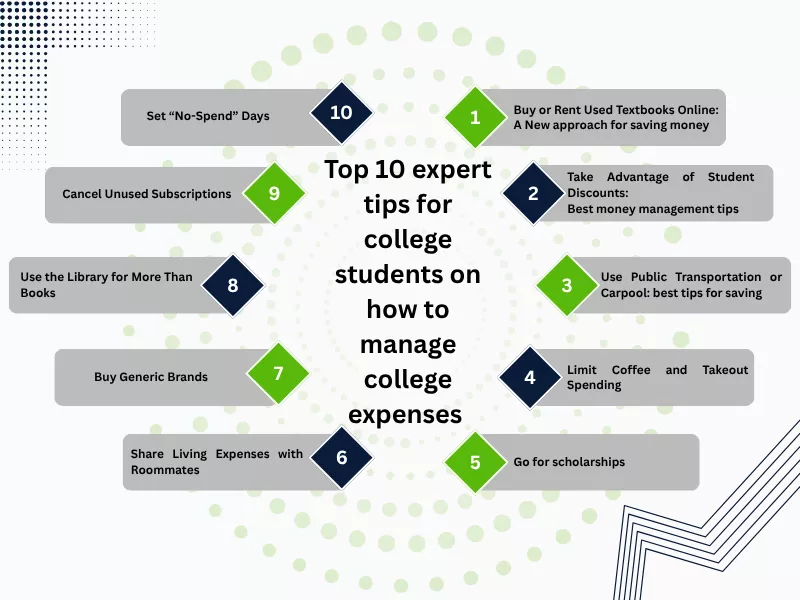

Managing your personal finances wisely is important in this era; hence, you must make smart academic choices to save money and reach your financial goals faster. Budget stress? We’ve got you covered. Our paltoform experts will provide budgeting tips for college students to help you manage your money smartly in 2026.
If you’re trying to budget better or make informed financial decisions, consider these ten tips from boostmygrade experts for quick money management:
College life is exciting, but it can also drain your wallet fast. One of the easiest tricks to save money in college is to buy or rent used textbooks online. Why pay full price when you can get the same material for less? Remember, College is a time to learn to be smart, not just study hard.
But here’s an even smarter move: you can skip buying several books altogether and choose a Online class help service. In such services, you’ll get expert tutors available for all subjects, and they will also take your online class. Another best thing? Get guidance, assignments, and study help in one place, and you do not have to pay for each book separately. Last but not least, with this, you’ll feel less financial stress and be able to save money in college.
So, before spending hundreds on books, explore affordable options like buying used textbooks instead of new ones, as they’ll save you money and help you focus on what truly matters: your education and future success.
Trying to manage your money or looking for smart tips for saving in campus life? Do not worry, this hack makes a difference. Skip paying for expensive software like Microsoft Office, Adobe, or streaming services like YouTube Premium. There are numerous Benefits of Paying for Online Class Help. Let’s see what advantages you can take by paying someone to do an online class.
Without paying extra for multiple study websites, take expert help for studies, manage your student budget, and achieve good money management. It’s a wise choice that lets you save in the long run, reduce daily expenses, and focus on your studies without financial stress.
So, before subscribing to multiple costly tools, make a budget, think long-term, and choose smarter, as sometimes, one expert solution can save you more than ten unnecessary subscriptions!
Attending university and looking for smart ways to manage money? Then this is one of the most effective tips to cut costs. Instead of driving your own car, which adds up in fuel, parking, and maintenance, use public transportation or carpool with classmates. It helps college students like you who can build their emergency fund.
Using these options helps you build a budget and better manage your monthly expenses. Therefore, it also preserves your money for unexpected expenses and removes financial difficulties. You can then use those funds for necessary expenses, such as your meal plan, textbooks, or even to pay debt.
It allows students to manage unexpected expenses that may arise during the semester. Small choices like this, learning financial literacy, can reduce unexpected financial burden. So next time you plan your route, skip driving. Ride smart and save money in the long run!
Daily café runs increase your spending! Instead of spending $3–5 a day on lattes, brew your own coffee or prepare quick meals at home. Small habits like this can make a big difference when budgeting for college and paying for it without stress. Cafes such as Chipotle, Subway, and Chick-fil-A also offer student discounts, so always check before you swipe your card.
Now, apart from food, coffee shops are also used to attend online classes or do homework. The good news is you can avoid spending cash on such a cafe by taking tuition help from the Online Class Help Service and finally catch up on sleep. It’s a smart way to help university students manage their time and energy while focusing on what really matters, such as grades and growth.
Attending college, but don’t know about scholarships? Don’t make this mistake, as it can pay off your balance without hurting your pocket. Opting for a scholarship means you will get direct financial aid, and the best part is that it doesn’t require repayment like student loans.
Receive about $14,890 per year through a scholarship in America, which will pay your 29 % tuition fees. Use sites like Bold.org and Scholarships.com to search for opportunities in America. So, if you’re serious about budgeting for college and want to avoid unnecessary debt, start applying now. Don’t wait, as it could be just a few clicks away. Trust me, future you will thank you for making this smart financial move!
Thinking of creating a budget? Share accommodation with your friend now! It is one of the smartest ways to cut costs. The main reason is that when you share accommodation, you automatically save on rent, groceries, and internet bills, which can easily save you hundreds of dollars every month.
This clever hack will also help you to learn real-world skills like bill pay, financial responsibilities, and managing your cash. Plus, it’s more fun as you’ll always have someone to study, cook, or hang out with after class.
Think of it this way: instead of spending all your funds on rent and monthly expenses, you can use that money for necessary expenses. It’s a simple and smart move to keep more cash in your pocket.
Another hack that we can give is that use or buy generic brands to lower your expenses. This will help you cut down your costs. In addition, generic brands are sold at lower prices than branded ones.
For example, generic medicines in the USA cost about 79 % less on average than brand-name drugs. Last but not least, buying things from a generic brand will save about 40% of your funds, and you will not have teh shortage of funds.
We think that the library isn’t just for borrowing books, right? It’s actually one of the best ways to cut back on costs. Many libraries offer free access to software, research materials, and basically provide things that you’d normally spend a lot on.
Apart from this, libraries also offer free workshops and study rooms that can replace paid subscriptions. Check what your library offers, instead of buying textbooks or paying for extra study tools. So next time, skip the spending and head to the library instead!
Here is a quick question: have you checked your monthly subscriptions lately? You’ll be surprised to know how much money slips away from subscriptions like Netflix or Hotstar, which you hardly watch. Now what? Go through recurring expenses and cancel the ones that you don’t really need right now.
Think of it this way: every unused subscription is cash on hand you could save for essential things. In addition, managing the expenses isn’t about cutting every fun activity. It’s about being smart with where your money goes.
Free up $30–$50 a month by cancelling any subscription you do not need right now. So take five minutes, check your bank statement, and see what you can let go. Trust us, your future self and wallet will thank you!
Did you ever try having a “No Spend “ day? It’s simpler than it sounds: just pick one or two days a week when you won’t spend any money at all. Try to avoid fun activities; instead, use that time to watch YouTube videos on skill development, hang out with friends on campus, or try free activities such as group study.
This will help you notice where your money usually goes and build better control over your spending habits. You’ll also start realizing that you don’t need to spend to have fun or feel productive. Furthermore, it’s a small step, but one that teaches smart money habits for life.

The shift to online learning has brought about incredible flexibility but also new challenges. According to the 2025 survey, 59% of learners struggle to stay motivated in online classes. This problem is similar to the LMS challenge, as accessing the LMS can be difficult. Are you struggling to stay motivated in an online class or with finding notes in the LMS Platform? Fear not, you are not alone; many of your fellow students are in the same chapter.
Thankfully, Online Class Management Services are here to transform your academic journey and help you with LMS challenges. Thus, it makes your academic journey smoother and more organized. In this blog, we will discuss how Online Class Management Services Can Transform Your Academic Life.
An online course management service is basically your digital classroom. It’s a super handy platform that helps you to create, manage, and access all your online courses in one place. You can think of it as your one-stop learning hub; here you can find lecture notes, notes, and quizzes whenever you need them.
Now you do not need to search for your notes through emails or random files. Get everything in the online class management services whenever you need to study. It’s organized and easy to use!
Online Class Management Services make learning easier for you.
The best part? You can access everything from your phone or laptop anytime, anywhere. It’s super flexible and easy to use, making online learning way more convenient and fun!
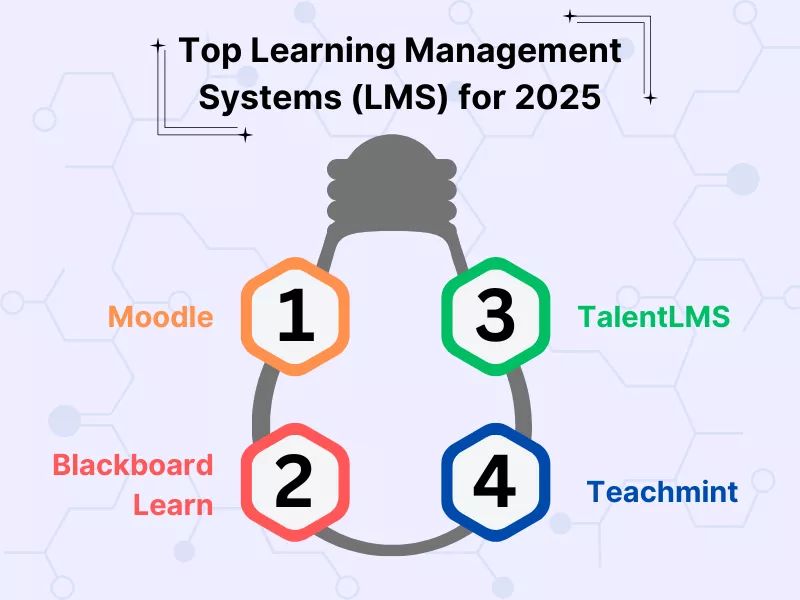
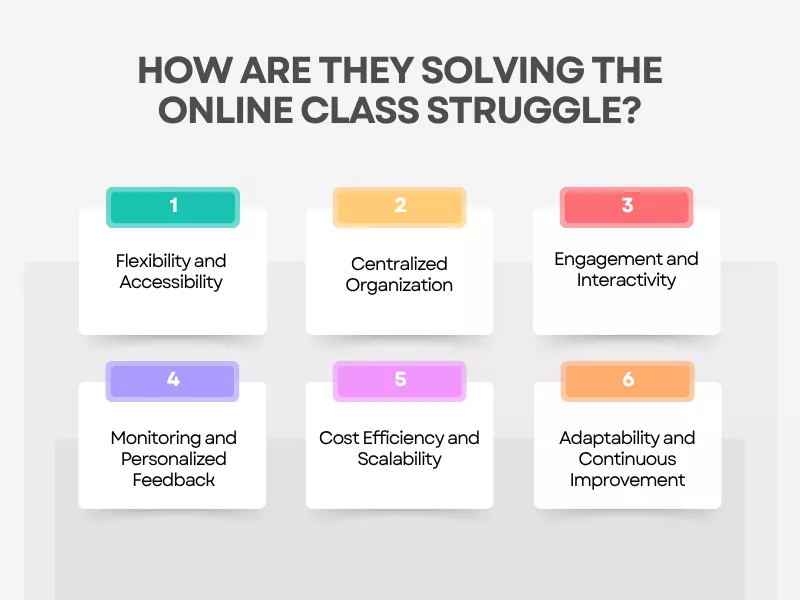
Make your online learning get way easier and more organized with a Learning Management System. If you’ve ever struggled with staying on track or have found difficulties in course material, an LMS has your back. It keeps everything in one place, making your study more structured. Hence, it can be said that the Online Class Management Service makes learning a lot more engaging and accessible.
Make your learning super easy and flexible with LMS. In these systems, you can log in and access your classes, notes, and assignments anytime from your computer, tablet, or even your phone. This is perfect if you have a busy schedule; ultimately, this is the best time management for students. For students. With this flexibility, you won’t miss lessons and can learn at your own pace, in the way that suits you best.
In an LMS, you are saved from jumping between different applications. Another good news is that you also do not need to search through endless folders. Your notes and class requirements are kept in one place in an LMS platform. In other words, it stores your notes, assignments, grades, and even messages from instructors.
It’s like your personal classroom; you can keep everything neat and organized here. No more missing files or last-minute panic before deadlines! Plus, teachers can easily update lessons or share feedback, so everyone stays on the same page.
The best thing is that an LMS platform is not just about uploading boring PDFs anymore. These platforms have turned into full-on virtual classes where you can feel fun and interactive. Over 10 % have reported that they continue to complete their studies even when facing challenges with an LMS. Last but not least, an LMS platform will help you with time management and make it easier for you to stay on track and remember what you have learned.
One of the best things about an LMS platform is that your tutor can track your progress in real time. They can see instantly how you’re doing with your courses and see if you’re struggling with a topic. The best thing? They step in with extra help or feedback before things get messy.
It also makes your learning more affordable and convenient. In addition, you donot have to spend money to travel, print notes, or attend physical classrooms; here everything’s online and easy to acess. The best part? An LMS can manage without any extra hassle or cost despite numerous studnets. It’s flexible, budget-friendly, and perfect for growing with your learning needs!
An LMS platform makes learning feel more personal and tailored just for you. It can suggest courses or lessons based on what you already know, your skills, or what you need to learn next. Pretty cool, right? On top of that, tutors can use built-in analytics to see what’s working and tweak the content to make it even better. Hence, LMS makes your study schedule optimization easy.
In simple terms, LMS helps teachers figure out what’s working and what’s not, so they can make learning better for you. Last but not least, you get a learning experience that actually fits you, not just a one-size-fits-all approach.

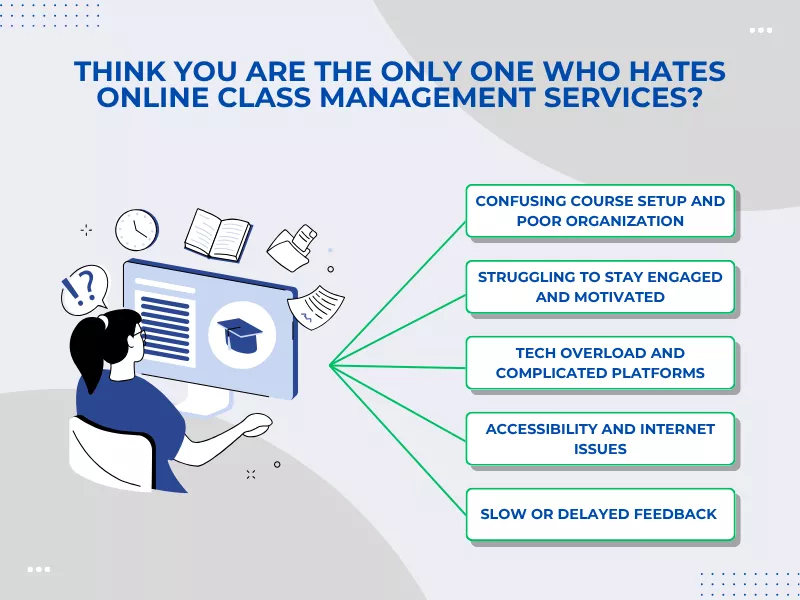
Think again! Let’s be real, managing an online course through online class management services isn’t as easy as it seems to be. While you might be facing one problem, others are facing something else. For instance:
Have you been in a situation where you logged into an LMS to find your weekly task and spent hours figuring out where your assignments are? If yes, then yeah, that’s a real issue. The main reason behind this is that you find it harder to stay on track when every tutor organizes things differently, with due dates, and files become misplaced. This lack of consistency can easily lead to missed deadlines and frustration.
Since you have spent hours finding out your weekly assessment, it’s quite natural to lose motivation. On top of this, you will feel frustrated as you won’t get the opportunity to connect with anyone. Thus, you will procrastinate more due to low motivation. And the result? You will miss the deadline, and this will compromise your grade.
Apart from losing motivation, if you aren’t tech savvy, LMS platforms can feel like a maze due to too many tabs, too many tools, and unclear direction. The frustration will arise especially when you have proper knowledge about your subject but don’t have the proper training about LMS. Your grades will be compromised despite having proper knowledge of this petty issue.
Another issue that can compromise your grade, despite studying, is a lack of access to modern gadgets or fast Wi-Fi. Think you have studied the whole night for your maths subject, but during the online exam, your internet stopped working. This will do nothing but wash away the efforts that you have put into performing well in the exam. Similarly, you will also not be able to study from the LMS if there is a network issue
Now we have discussed so many challenges regarding LMS, the last challenge comes which is delayed feedback. For example, if you have completed your project in one week, but your tutor is giving feedback after 2 weeks due to a lack of LMS training. This situation will aggravate more if you get feedback in 2 to 3 days before your final submission. Unfortunately, you will lose the chance to fix mistakes in your assignments if you do not communicate with online class tutor on time.
In managing the LMS challenges at a virtual classroom organization, Online Class Help Services plays a crucial role. Here we will discuss why these services are best if you are struggling:
If you ever worried about how to manage online classes effectively in college? Connect online class help services.
This blog has provided information about the online course management services and their importance in your life. An LMS paltoform has importance in solving your online class struggle, but many complications make the LMS an extra burden on you. However, online class help services are available to assist you in solving these issues.
Connect them now!
In an LMS, common academic files such as PDF, DOC, and PPT are uploaded. However, TXT and ZIP files are also sometimes supported. Always check the instructions for specific requirements before submission.
If you are having an outdated web browser or slow internet, then your course video might not load in the system. In addition, if your security settings are blocking the media player, then you may also have this issue.
It actually depends entirely upon the policy of the instructor. The system may automatically block late submissions, or it may allow them while marking the submission as late. Always check the syllabus first.
Canvas is a web-based learning management system, and it is used by learning institutions, tutors, and learners to access and manage online course learning management materials.
Moodle is a good LMS for learners. This platform provides several benefits, like :
You can use an LMS software to track your online course. Since LMS records automatically when a student completes a specific activity or module, it becomes easier for you to track assignments.
Disclaimer : BoostMyGrade.com offers academic assistance through model papers and study materials for research and learning support. These materials are intended as examples and should not be submitted as original work. We do not support plagiarism, academic dishonesty, or violations of institutional policies.