
When school happens online, how to ask questions in online classes matters more than ever. Since digital classrooms differ from regular ones, students need new habits to adapt. Pausing before speaking allows learners and teachers to process ideas, making clarity easier. Thinking about possible answers first before asking a question helps students build insight, confidence, and smoother participation.
Tips rooted in real experience encourage natural engagement, balancing curiosity with discussion flow. These rhythms, not rigid rules, create an environment where students feel comfortable thinking, sharing, and contributing effectively. In many ways, these practices reflect the best ways to ask questions online and support meaningful learning in virtual spaces.
They have their own performance to elaborate the things
Key Takeaways
- Prepare ahead by reviewing materials early and noting focused questions.
- Use ToolUse tools like chat, hand-raise, or breakout rooms without interrupting.
- Ask clarifying or open-ended questions to improve understanding.
- Maintain etiquette by being polite, concise, and speaking at the right time.
- Handle technical issues calmly and avoid asking questions during disruptions.
- Follow up wisely by building on explanations and avoiding repetition.
- Engage actively to show interest and build strong connections.
Why Asking Questions Matters in Virtual Learning
The process of virtual learning requires students to ask questions respectfully. This helps them learn more effectively during their online courses and ask effective questioning in virtual classes. Online courses often use discussion questions to improve students’ comprehension skills. The online environment creates difficulties for questions because it lacks body language and instant verbal responses, which makes it harder for people to recognize their significance.
Virtual classes use effective questioning methods to assist students in developing critical thinking skills while they participate in deeper learning experiences.
- Figure out tricky ideas as you go along
- Stay present, keep your attention steady
- Demonstrate participation and interest
- Build stronger connections with instructors
Still, if questions come at bad moments, they might interrupt class, mix things up for others, or slow everyone down. Knowing when to speak online or in person matters as much as speaking itself, especially for asking questions during online class without interrupting.
Effective questioning in virtual classes methods to assist students in developing critical thinking skills while they participate in deeper learning experiences is an essential part of the best practices for questions in online education.
How to Ask Questions Effectively in Virtual Classes?
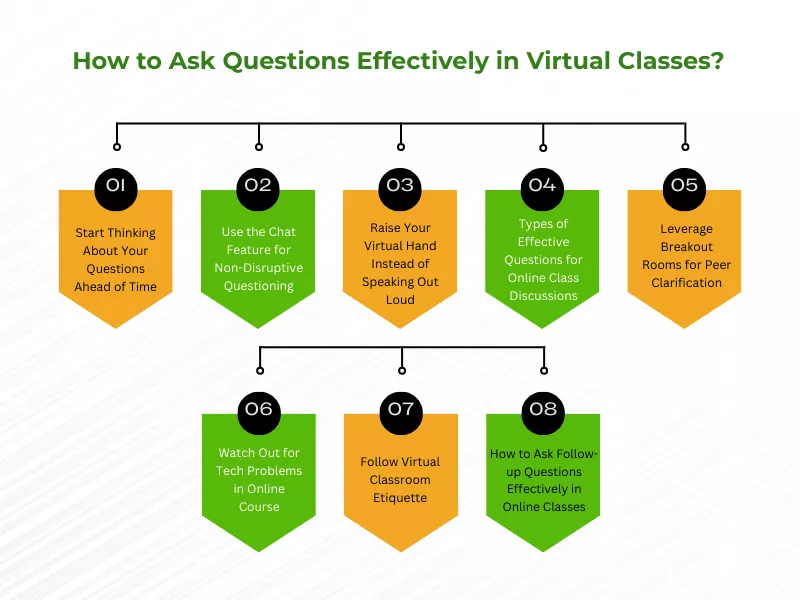
1. Start Thinking about Your Questions Ahead of Time
Getting your thoughts clear early helps ideas grow naturally. This habit supports preparing questions before online class sessions, making each question sharper and more purposeful during live discussions. Begin by preparing yourself for the semester using essential tools for online students. Once the class begins, you’ll find everything ready on your screen – the class waiting just like any other online course. Many learners appreciate this setup, especially when working without fixed real-time schedules.
- Check the last class materials and slides to prepare for the upcoming assignment and enhance your reading of the course content, especially for those in the school of education.
- Identify areas of confusion to stimulate further discussion.
- Ahead of time, list the exact questions you want answered to check for understanding.
- Rank questions by importance
Ready-made questions tend to shine better – sharper, narrower, simpler.
2. Use the Chat Feature for Non-Disruptive Questioning
When talking in class, learners can send questions through a chat box. Focus holds the key, keeping discussions tied to the subject at hand. For replying, check what others just said. This way, participants stay on track without interrupting others, while also learning how to phrase questions in online class settings more clearly.
Say you want to talk about the part right after this lecture. Pointing to slide number seven by asking, “Does this formula fit the case shown here?” helps things move forward. It shows real curiosity instead of just checking off an answer. The way it’s framed makes it feel less like questioning and more like clearing up details of a person reading that would likely respond with an explanation rather than evasion.
At times, educators might turn to chat to gather questions, then answer them just when they matter most, keeping the class moving without pause.
3. Raise Your Virtual Hand Instead of Speaking Out Loud
A question comes up to check for understanding. Encouraging speech matters here. The “Raise Hand” tool works best without sounding harsh. Respect shows in how it is used, especially when students feel comfortable sharing their thoughts.
Only talk when your teacher says it’s okay, especially in an online teaching environment, to maintain a respectful atmosphere for critical thinking. Some students search for shortcuts like Pay someone to take my online class, but active participation and asking questions build stronger understanding in the long run. If someone shows slides or talks through tricky ideas, just wait—time moves faster that way. This way feels like being in a real classroom, only now it happens behind a screen, which encourages critical thinking in a digital environment.
4. Types of Effective Questions for Online Class Discussions
Online class discussions depend on the questions that students choose to ask because both open-ended questions and choice questions determine the depth and effectiveness of their discussions. Instructors need clear questions that serve a specific purpose because this method enables them to provide effective answers, while students can participate without confusion. The most effective question types for online learning environments are listed below.
- Open-ended questions
- Clarifying questions
Example:
Breakout Room Activities and Essential Tools
Breakout rooms are small-group sessions in virtual classes that encourage collaboration, discussion, and hands-on learning. They create a supportive space that shows how students ask questions in virtual classes more confidently and naturally. Participants explore concepts through tasks, case studies, or problem-solving, with roles like facilitator or note-taker ensuring structure. Afterwards, groups share insights to reinforce understanding.
5. Leverage Breakout Rooms for Peer Clarification
A good moment to speak up happens when the discussion shifts, not during it; this is one of the best practices for effective communication in an in-person setting and in a virtual environment. These habits also help students improve questioning skills in virtual classroom interactions. Breaking into smaller groups works well if someone needs to ask something quickly. Interrupting the speaker slows things down more than expected. Questions fit better after the main point has been covered, allowing for more targeted and general questions.
When kids gather in little teams, they usually sit more easily
- Asking “basic” questions
- Exploring alternative explanations
- Working together to learn
6. Watch Out for Tech Problems in Online Course
To deal with Online Class Technical Issues, such as delayed sound, stuck videos, or dropped connections, it can be helpful to verbalize concerns to peers for better understanding. If someone asks a question too soon, problems pile up fast.
Students must solve online classroom technology issues by providing immediate solutions.
- Students should refrain from asking questions during unstable audio or video situations because it provides limited assistance for their material comprehension.
- Save those tricky tech queries for later when things settle down, so you can focus on the effective online discussion questions.
- Let instructors know if problems make lessons tough – do it calmly, provide constructive feedback, and ask students how they feel about the content.
- Working within these bounds makes meetings run more smoothly, lessening tension and fostering informal communication among participants.
7. Follow Virtual Classroom Etiquette
Asking questions becomes easier when people follow basic online behaviour rules, which include using appropriate question types.
Etiquette tips: remember to phrase your comments and questions clearly to facilitate better communication.
- Mute your mic if you stop talking
- Use polite and professional language
8. How to Ask Follow-up Questions Effectively in Online Classes
Before asking:
- Check first if anyone else has filled it in, as many students rarely ask the same question twice.
- Build on the instructor’s explanation by asking relevant questions that connect to the syllabus and encourage peer-to-peer dialogue.
- Stay concise to maintain the attention of students in an online class.
Thoughtful follow-ups demonstrate engagement and reflect strong tips for asking questions in virtual learning.